
Section: System dynamics
Do you need a system?
Great teams don’t move fast because they skip structure, but because they build on it.
Across the tech industry, teams are being asked to move faster with fewer people. The word lean has quietly turned into less. Systems work is often one of the first things to go. On paper, removing structure looks efficient. In practice, it erodes the foundations that make efficient work possible. Ironic.
Artificial intelligence is making this tension sharper. As tools begin to design, code, and ship faster than ever, systems help teams remember what fast work forgets. Without solid shared foundations and documentation, AI will only accelerate the chaos, producing more but meaning less.
Good systems slow you down in the right places so everything else can move smoothly. Josh Clark describes this clearly in his article Ship faster by building design systems slower.
Successful design systems move more slowly than the products they support. That’s a feature, not a bug.
 Josh Clark Principal, Big Medium
 The Linear example
Section titled “The Linear example”When a short video titled “Why Linear didn’t build a design system” started circulating, it sparked debate. Some used it as proof that systems were unnecessary, but if you listen closely to the three-minute video, you hear something else:
Linear did have a system, a lightweight internal one. It lived inside shared Figma libraries and code, consistent habits, and a tight culture of trust. For a small, highly skilled team working side by side, that was enough. Their coherence came from proximity and shared taste, not documentation.
The lesson isn’t that systems slow teams down. It’s that every team already has one, whether they call it that or not. The question is whether it’s intentional, maintained, and able to grow as the team grows.
Understanding context
Section titled “Understanding context”Two factors define when and how much structure a team needs: size and maturity. But before either of those, it’s worth remembering what the system exists for. A system is never the goal. The goal is the experience: how it feels, how the brand comes through, and how clearly it helps people do what they came to do. Systems exist to serve that clarity, not to replace it.
A healthy system amplifies that intent. It connects design, code, and content so everything reflects the same care. When the system becomes an end in itself, it risks drifting away from the people it’s meant to serve.
Team size
Section titled “Team size”Small teams can stay consistent through conversation. Alignment happens in real time. As teams grow, that implicit coordination fades. Variations multiply. Each new hire adds diversity and distance. Systems become the glue that conversation used to provide.
Team maturity
Section titled “Team maturity”Maturity isn’t about seniority or years of experience. It’s about awareness and the ability to see how individual work affects the whole. Some people think in systems naturally. Others learn over time. The danger comes when confidence grows faster than capability. That’s when incoherence spreads, often confused as “creative freedom.” Low maturity often looks like high maturity because progress is visible, but coherence is not.
The role of leadership
Section titled “The role of leadership”Leadership plays a crucial role here. Good leaders see maturity as a shared practice, not an individual trait. They connect teams around a common standard, help people understand why that standard exists, and create space to challenge it safely. They don’t impose rules; they nurture perspective.
In teams that understand systems, structure is seen as collaboration, not control. Mature leadership recognizes that clarity creates autonomy. When people know the rules, they can bend them responsibly. When clarity disappears, leadership ends up in every conversation that used to depend on shared standards.
The system need and impact on experience
Section titled “The system need and impact on experience”Every team reaches a moment when scattered effort starts to slow progress. The question isn’t whether to build a system, but how much structure your current reality calls for. Systems don’t mature ahead of the organization; they mature with it.
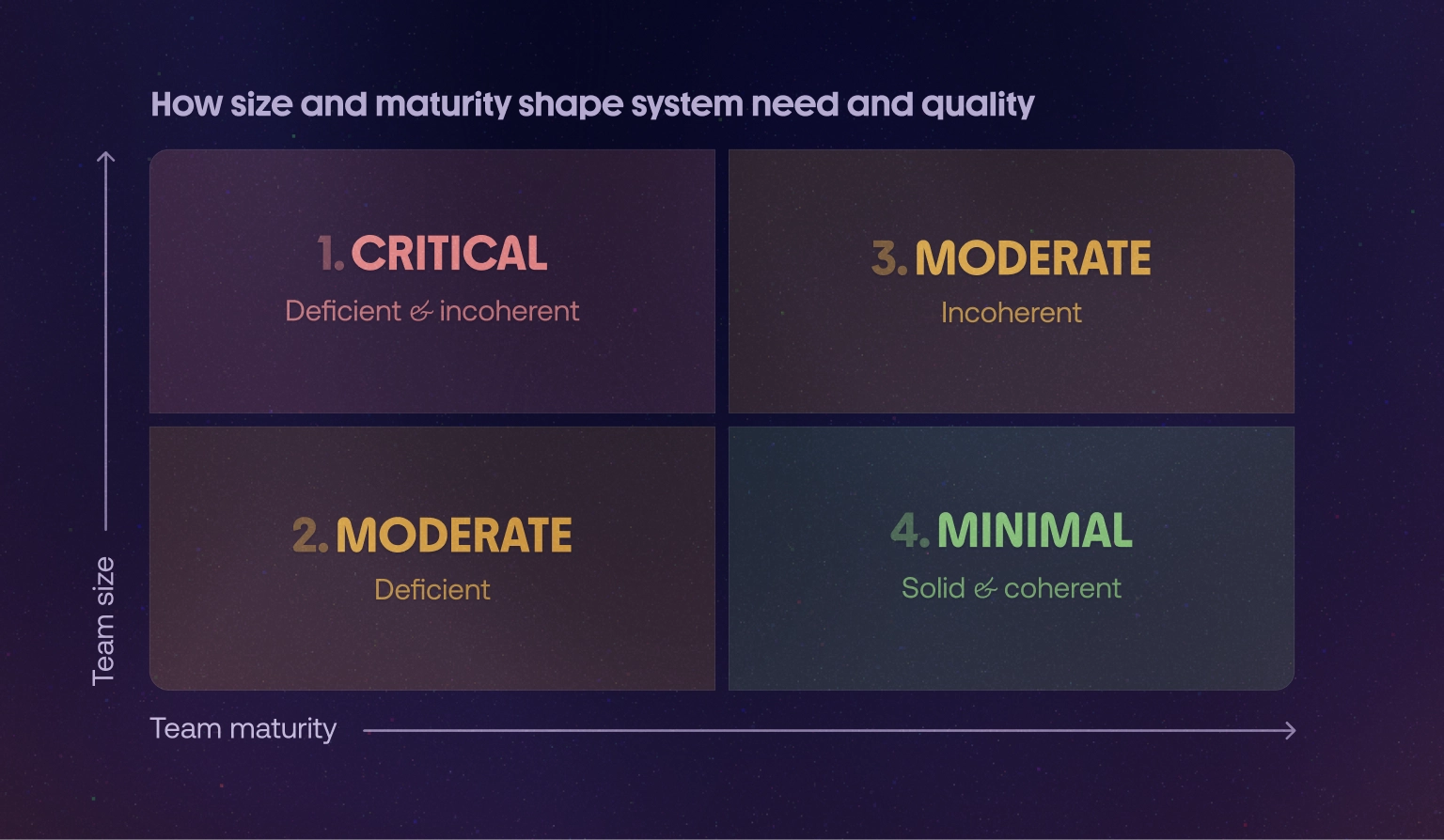
A visual model showing how system need changes with team size and maturity. Small, mature teams often stay coherent with minimal structure. Large, less mature teams face higher risk of inconsistency and inefficiency.
Let’s break it down:
- Large team, low maturity: Critical need. Quality and consistency collapse. Systems become essential for survival.
- Small team, still learning: Moderate need. Talent is there, but shared habits aren’t. Systems help the team align and grow.
- Larger team, capable but fragmented: Moderate need. Work looks strong in isolation but feels disconnected together. Systems reconnect intent and delivery.
- Small, experienced team: Minimal need. Shared understanding replaces formal process. A light system keeps things coherent.
Some assume the maturity of the product determines when a system is needed. That assumption can hold teams back. Systems don’t need to come after maturity; they can help create it. The right level of structure at the right moment supports experimentation instead of constraining it, making work faster and more deliberate even in early stages.
Any startup that I’ve worked on, that’s always the first thing that I’ve built because it lets me go fast.
 Henry Modisett VP of Design at Perplexity
 The goal isn’t to reach “minimal.” It’s to understand where you are and let the system grow at the pace your reality demands.
Assessing maturity
Section titled “Assessing maturity”You can often feel the cracks before you see them. Listen for the signs:
- Work gets duplicated.
- Teams rebuild the same components differently.
- Interfaces feel slightly off, even if you can’t say why.
- Decisions depend on who’s in the room, not on shared principles.
- Documentation is outdated or ignored.
- The systems team becomes the scapegoat for moving “too slowly.”
When that happens, the problem isn’t efficiency; it’s understanding. Systems exist to turn coordination into clarity. Without them, coordination takes over creation.
Leaders can respond in two ways. They can blame the system for being slow, or they can help the team mature into using it. Pair people across disciplines. Reward those who collaborate and teach. Create time to explain the why behind every decision.
System literacy needs to be part of the job description for everyone in brand, design, content, engineering, and product. Career paths should reflect that. As AI takes on more of the work, systems and documentation become the bridge between human intent and machine output. Without them, we’ll keep repeating the same mistakes, only faster.
The right structure doesn’t just shape the product; it shapes the team. Work becomes clearer, collaboration smoother, and progress more consistent. This shared foundation creates long-term value that many teams underestimate.
The cost of denial
Section titled “The cost of denial”The real cost of cutting system work rarely shows up right away. It appears in the decisions teams make without shared context. As the structure that connects design, content, and engineering gets thin, people rely more on guesswork and individual memory. The work keeps moving, but not in a healthy way. Small problems compound. People feel confident in the moment because they don’t see the gaps they’re creating, and low maturity can hide behind that confidence for a long time. By the time the inconsistencies pile up, the cost is much harder to absorb.
Systems don’t exist to add steps. They exist to reduce uncertainty. When that foundation weakens, teams spend more time resolving contradictions, clarifying intent, and fixing avoidable issues. It doesn’t feel dramatic at first, but it slows the work down and quietly erodes quality.
Mark Dalgleish captured this tension well:
Design systems are such a battle.
A battle against old ways of thinking.
A battle against old ways of working.
A battle against history.
A battle against inertia.
Still, we need to stop and appreciate just how far we’ve come. It’s actually quite remarkable.
 Mark Dalgleish Staff Engineer at Shopify
 When the wrong corners get cut
Section titled “When the wrong corners get cut”Once teams rely on workarounds instead of structure, small inconsistencies turn into bigger ones. Interfaces drift, onboarding slows, and nothing feels stable.
These problems grow quietly until they’re impossible to ignore. And when teams shrink or key people leave, the impact becomes sharper. Knowledge that used to be shared collapses into a few hands, and without a system to carry it, the work becomes fragile. Every person risks becoming a single point of failure.
The hope for aligned outputs emerging from independent federated contributors driven by altruism is at best misplaced. At its worst, it’s recklessly naive.
 Nathan Curtis Design systems consultant
 AI adds another layer. Tools can generate design and code quickly, but without clear foundations, that speed amplifies inconsistency instead of clarity.
This is where leadership matters most. Cutting system work doesn’t make a team more agile; it shifts the weight onto people who are already stretched.
A federated model can work, but only when there’s a strong center holding it together. Without a dedicated team to guide and maintain the system, priorities scatter, ownership drifts, and the system stalls just when the team needs it most.
Reflection
Section titled “Reflection”A system is any shared framework that helps people create work that feels clear, connected, and intentional. It can be language, workflows, principles, or tools; anything that keeps meaning aligned across disciplines. The goal is always the experience. The system exists to help teams deliver it more coherently across contexts, platforms, and time. When a system becomes the goal itself, it stops serving its purpose.
As AI accelerates creation, systems become the way we keep that meaning intact. They help both humans and machines understand how the work fits together. Progress isn’t about moving faster; it’s about moving with more intent.
Systems don’t stay healthy on intent alone. They need people who care enough to keep them clear, maintained, and shared. Leadership sets the conditions for that care to matter. When clarity, quality, and accessibility are treated as priorities, the team learns to protect them too. It often takes courage to slow down when everything around you asks for speed, but that courage is what makes the work last.