
Section: Fundamentals
Identity and expression
Coherent experiences are the baseline. Great ones come from an identity that can hold both function and expression as the experience evolves.
Building a coherent experience requires more than consistent outputs. It requires clarity about what holds steady and what is allowed to change.
Identity provides shared ground. Expression is how that identity responds to real contexts and constraints. This isn’t a traditional debate about branding or style. It’s a systems problem that shows up as friction between teams. When the relationship between identity and expression isn’t explicit, coherence becomes fragile and decisions drift into taste, local optimization, or politics instead of adding up to something intentional.
Many teams already understand a version of this through voice and tone. Voice stays stable. Tone adapts to the situation. This article extends that thinking beyond words to the entire experience.
The goal isn’t alignment for its own sake. It’s to create the conditions for teams to improve the experience together, deliberately and with intent.
Identity is who you are
Section titled “Identity is who you are”Identity is the part of the experience people come to recognize over time.
The same logic that applies to voice and tone applies here. Voice stays consistent. Tone adapts to what’s happening. You speak differently in different situations, but you still sound like yourself.
Identity works the same way. It’s the signal that remains recognizable across moments, even as behavior later adapts to different situations.
You often recognize identity when things are stripped back. Not in polished moments, but in what feels consistently true across everything you do. How clear the language tends to be. Whether responsibility is taken seriously. Whether people feel respected or managed. These signals don’t depend on context. They repeat.
Most teams already rely on identity, even if they don’t name it. Every time someone says “this doesn’t feel like us,” they’re reacting to a break in recognition. The work might still function. The message might still be correct. But something feels off.
That feeling comes from broken recognition.
A clear identity creates recognition across moments, not sameness across outputs. It allows different work to feel related without needing to look or sound identical. It gives teams a shared sense of what belongs together.
Identity doesn’t prescribe solutions. It defines the ground they stand on.
Quality is part of identity
Section titled “Quality is part of identity”Quality, as inclusion, isn’t something you add later. It must be part of who you are.
You feel it in how carefully things are made. In whether details hold up. In how predictable and trustworthy the experience feels over time. These signals don’t depend on style or expressiveness. They reflect how seriously identity is taken in execution.
That’s why quality belongs with identity.
Quiet work can be high quality. Bold work can be high quality. What matters isn’t how visible the work is, but whether it’s coherent, intentional, and respectful of the people using it.
When quality is missing, identity feels hollow. When it’s present, identity becomes credible. Over time, that credibility turns into trust.
Before teams decide how something should behave in a given context, they need a shared baseline for what “well made” means. What’s non-negotiable. What signals care, even when no one is looking. That includes things like clarity, reliability, accessibility, and inclusion.
Those answers don’t come from expression alone. They come from identity that has been shaped with real needs in mind.
Expression is how you behave in context
Section titled “Expression is how you behave in context”Expression isn’t what you believe. It’s what people experience in a specific situation.
If identity is your voice, expression is your tone. It changes depending on context, pressure, and intent, while still sounding like the same company. That’s why expression can’t be fixed. It has to respond to what’s happening.
You can see this when the same identity shows up in different moments. An onboarding screen, an error message, a marketing headline, a lifecycle email. The job is different in each case. The constraints are different. The behavior should be different too.
The same sentence can reassure in product and persuade in marketing without changing what it stands for.
- In product, expression often needs to get out of the way. Clarity matters more than personality. Precision matters more than flair. The goal isn’t to impress, but to help someone move forward without friction.
- In communication, expression can afford more emphasis. You may need to attract attention, create focus, or frame a story. That doesn’t mean abandoning restraint. It means using it differently.
A healthy system allows expression to shift without losing recognition. It accepts that different contexts demand different behaviors, and it designs for that intentionally. Expression isn’t about adding more. It’s about being appropriate.
The expression dial
Section titled “The expression dial”Expression doesn’t come in one fixed mode. It behaves more like a volume dial.
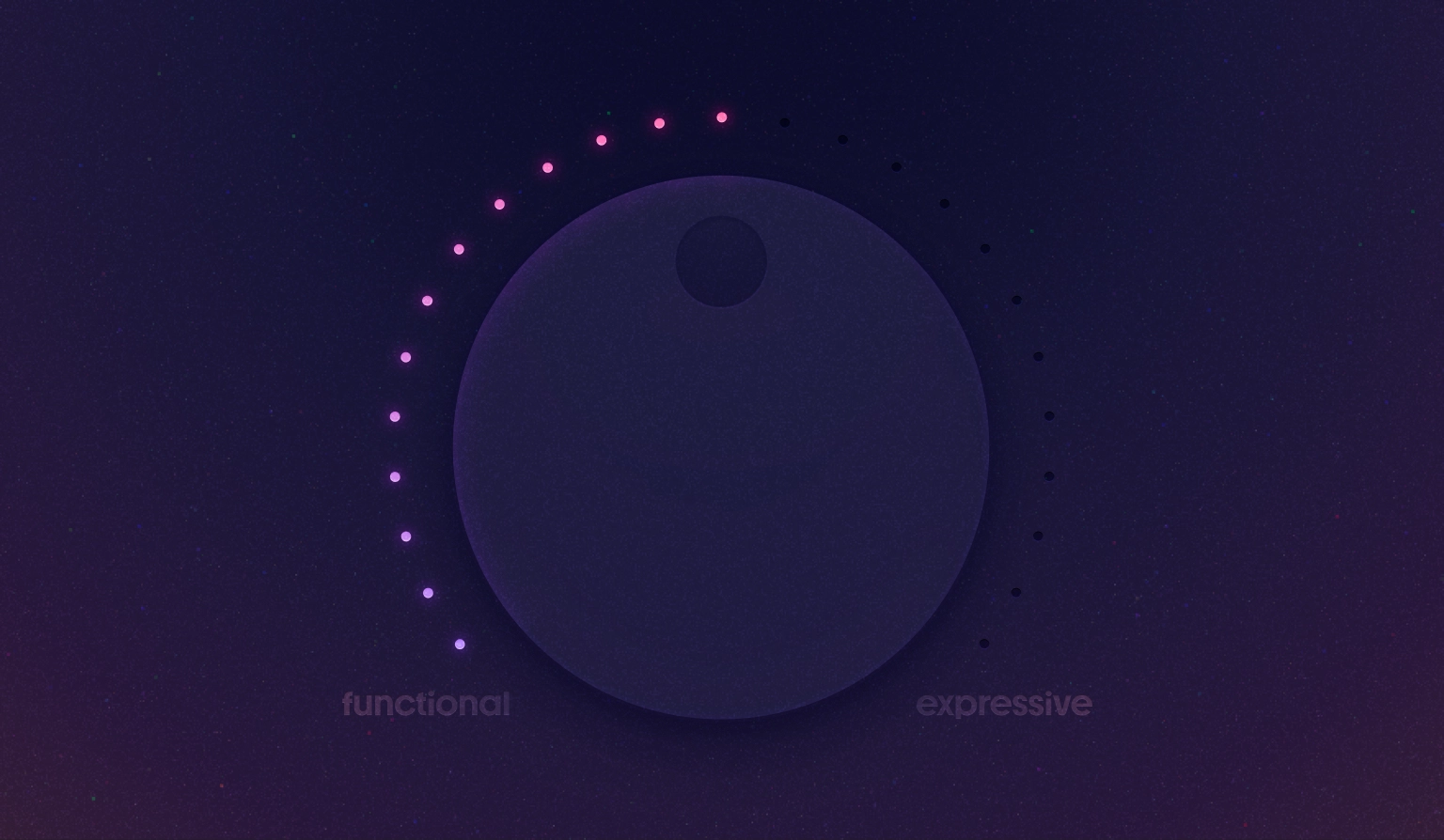
Expression is a dial, not a switch. Identity stays constant while expression moves between functional and expressive based on context and intent.
The question isn’t whether something should be functional or expressive. It’s how loudly you choose to be in a given context. How much presence the experience takes. How much it asks for attention.
- At lower volume, expression stays quiet. The work prioritizes clarity, predictability, and speed. Language is direct. Visuals are restrained. The experience stays out of the way so people can focus on what they came to do.
- At higher volume, expression has more presence. There’s room to create focus, set a mood, or tell a story. The work can afford more emphasis because attention is the goal, not efficiency.
Most real work lives somewhere in between.
A simple example is email (thanks, Roger). The intent of a message shapes how it looks, how it speaks, and how much emphasis it can afford. This applies equally to design and content. Tone, structure, and complexity should all respond to the same question: how much expression does this moment actually need?
| Intent type | Primary goal | Expression level |
|---|---|---|
| Transactional | Confirm or unblock an action | Low |
| Lifecycle | Guide or support progress | Medium |
| Promotional | Attract attention or persuade | High |
What matters is that the volume changes while identity doesn’t. Values, intent, and quality stay fixed. Only how loudly they show up shifts with context.
Expression shapes identity
Section titled “Expression shapes identity”Expression is where real needs surface.
Product reveals what clarity, accessibility, and reliability actually require. Content shows how meaning shifts across moments. Marketing exposes how much emphasis is needed to create recognition and emotion. These aren’t stylistic preferences. They are signals.
A strong identity doesn’t ignore those signals. It’s built to hold them.
That means identity can’t be designed in isolation and then applied everywhere. It has to be shaped with a clear understanding of how it will behave across contexts. Expression informs identity just as much as identity guides expression.
This is the work most teams never get the space to do. Not because it’s unrealistic, but because it sits between functions instead of inside one.
Where coherence breaks down
Section titled “Where coherence breaks down”Problems rarely start with expression. They start earlier, when identity isn’t strong enough to carry different behaviors across contexts.
When teams don’t share a stable identity, variation becomes risky. Instead of adjusting how something shows up, they compensate by changing what it is.
Often, the need driving that change is real. Product teams introduce new patterns to improve usability or accessibility. Content adapts language to reduce friction. Marketing evolves expression to stay relevant. The issue isn’t change. It’s that these needs were never allowed to shape the identity together.
You can often see this breakdown first in the artifacts teams touch every day. Visuals start to drift. Typography diverges between product and marketing. Color gets reinterpreted to fit local goals.
Content shows the same pattern. Language shifts depending on who’s writing and under what pressure. Messages get rewritten to fit campaigns or funnels. What was meant to be a shared voice turns into a series of local interpretations.
This usually isn’t a failure of execution. It’s a structural gap.
As a result, teams optimize locally. Marketing turns up emphasis to create recognition. Product turns it down to protect usability. Both decisions are reasonable in isolation. Systemically, they stop connecting.
Trying to fix this by standardizing outputs rarely works. It increases control, but not coherence. As soon as context changes, the cracks return.
A resilient system works differently. Identity is strong enough to support both quiet and bold expression. Quality holds across contexts. Teams understand when variation is expected and when consistency matters.
How ownership has to change
Section titled “How ownership has to change”Identity can’t live inside a delivery silo. Not because teams don’t collaborate, but because identity isn’t a local concern. It shapes how the experience behaves over time, across every surface. When it’s owned narrowly, the experience fragments by default.
This isn’t about teams failing to collaborate. It’s about collaboration being asked to compensate for a structure that was never designed to hold the experience end to end.
Somewhere along the way, brand ownership became associated with Marketing. That association was never about experience. It was an organizational habit that hardened into structure, without ever being examined for its consequences.
At some point, teams have to confront a deeper question: If brand defines who you are, why you exist, and how you show up, why is it so often owned where campaigns are optimized, rather than where the experience is built and maintained?
When identity is treated as a marketing output, Product Design and Content teams are left expressing an identity they are not allowed to shape.
That inversion has consequences.
Identity turns into something that gets handed off instead of something that holds the experience together. It becomes a deliverable rather than a foundation. Teams are expected to apply it, but not to evolve it. They compensate through interpretation, local fixes, or workarounds that keep things moving while slowly eroding coherence.
That restriction doesn’t just slow teams down. It caps how good the experience can become. It limits how teams understand the experience end to end, and it pushes the work of holding things together onto individuals who can feel the gaps but aren’t empowered to close them.
So the real choice isn’t organizational neatness versus collaboration. It’s whether identity is allowed to act as the ground beneath the experience, or whether it remains just another output in the chain.
When ownership is flipped, the experience doesn’t just become fragile. It becomes optional.
What great looks like
Section titled “What great looks like”When coherence stops being fragile, teams get their energy back. They don’t stop discussing fundamentals. They stop rediscovering them in isolation. Instead, fundamentals become something teams are allowed to improve together, with full awareness of how the experience behaves across contexts.
This changes the nature of the work.
Designers and content writers are no longer limited to applying decisions made elsewhere. They can contribute to the foundations themselves, informed by product reality, communication needs, and lived constraints. The system becomes something people actively shape, not something they work around.
This shows up clearly in how systems are structured. Shared foundations are visible and treated as infrastructure, not as brand assets. They hold across product, marketing, and content, while expression adapts based on context and intent.
eBay’s design system makes this explicit.
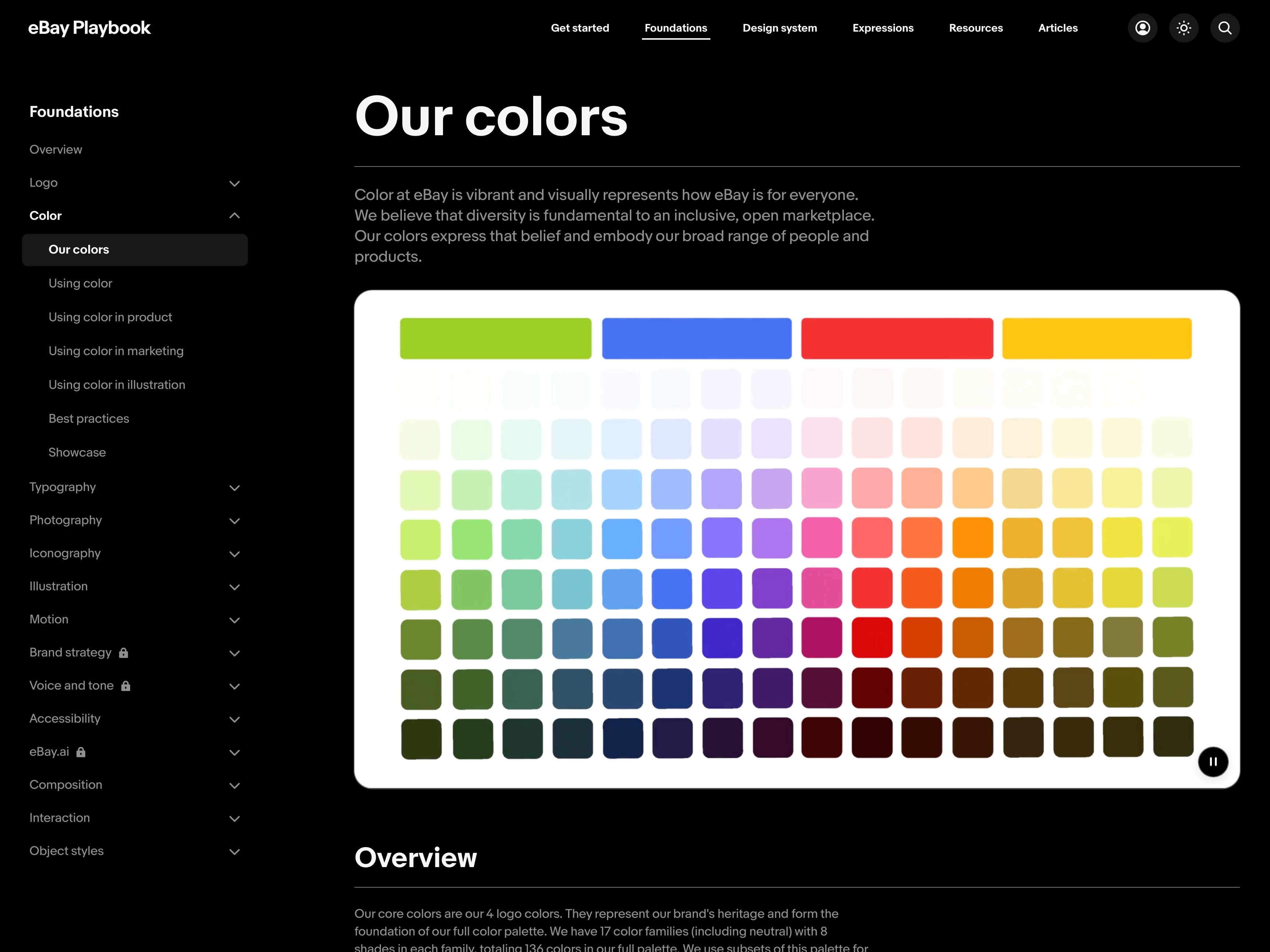
One shared foundation supports multiple expressions across product and marketing without fragmenting identity.
In setups like this, change is never purely local. A product need to adjust a color, contrast, or token immediately raises broader questions, because those elements carry meaning beyond a single surface. That’s not friction. It’s an invitation to think together about what should evolve and what should remain stable.
The point isn’t control. It’s participation.
When foundations are explicit and shared, talented people across disciplines can bring their context into the conversation. Product realities, content nuance, and communication needs all inform how the system grows. That’s where the work starts to feel bigger than a single team.
Documentation plays a critical role here. Not as a static reference, but as an interface for shared reasoning. It makes decisions visible, captures intent, and allows foundations to evolve deliberately instead of by accident.
The experience that emerges from this way of working feels confident. Not because everything looks the same, but because changes feel earned.
Function and expression reinforce each other instead of competing for space.
This is the payoff of an identity that can hold different expressions. It doesn’t limit ambition. It creates the conditions for teams to build something together that’s stronger than any single contribution.
Reflection
Section titled “Reflection”Working across product, brand, and content over the years, I’ve learned that most experience problems don’t start with design decisions. They start with organizational ones.
Teams rarely disagree because they want different outcomes. They disagree because they’re optimizing for different constraints. Product protects clarity and reliability. Marketing protects attention and recognition. Content tries to make sense of both.
Over time, I’ve come to believe that identity should not be protected from reality. It should be shaped by it, deliberately and with care.
When teams share a clear understanding of identity and how expression can adapt, tension doesn’t disappear. It becomes productive. Trade-offs are easier to navigate. Decisions take less energy.
That shift isn’t about taste or agreement. It’s about clarity at the right level.